

The Real Enemy of Team Performance Isn’t Your People
- 1 day ago
- 4 min read
(And Why Most Team Interventions Miss the Mark)
There is a quiet frustration sitting with many HR managers and team leaders right now.
On paper, the team looks fine. Roles are filled. Targets are defined. Meetings happen. Yet momentum feels brittle. Engagement is uneven. Initiatives stall. When pressure rises, communication thins instead of strengthening. Team performance is more than motivation.
The reflex is familiar: “We need to do something for the team.”A workshop. A strategy day. A teambuilding session.
Sometimes it helps. Often it doesn’t.
Not because teams are incapable. Not because leaders are failing. But because the wrong enemy is being fought.
The Enemy of the Hero: What’s Actually Undermining Teams
In most organisations, the default explanation for underperformance is people-centric:
“They’re disengaged.”
“They don’t take ownership.”
“They resist change.”
“They don’t communicate.”
These explanations feel intuitive — and they’re usually incomplete.
After working with hundreds of teams every year (on average, over 900 team experiences annually), a consistent pattern emerges: Most teams are not broken. They are operating inside environments that quietly reward disconnection.
The real enemy is not motivation, attitude, or capability.
The real enemy is disconnection under pressure.

When stakes rise, when time compresses, when decisions matter — that’s where teams reveal how they actually function. And in many workplaces, those conditions are avoided rather than designed for.
Why Most Teams Appear “Fine” Until They’re Not
In low-pressure environments, teams can function for years on politeness and habit.
Meetings stay surface-level.
Problems are discussed indirectly.
Accountability diffuses instead of landing.
Leadership becomes positional rather than visible.
Nothing explodes — so nothing changes.
The issue isn’t that people don’t care. It’s that the system never requires clarity. Without pressure, teams don’t have to test their assumptions, communication habits, or decision-making pathways.
This creates a dangerous illusion: things feel stable right up until they aren’t.
Why Traditional Teambuilding Often Fails to Shift Anything
Many team interventions fail for one simple reason: They focus on experience, not exposure.
The Entertainment Trap
Activities designed to be safe, fun, and agreeable rarely surface real dynamics. They create temporary positivity without touching underlying patterns.
That positivity fades quickly — often replaced by quiet cynicism:“That was nice, but nothing actually changed.”
Talking About Teamwork Isn’t Teamwork
Discussion-heavy workshops assume insight leads behaviour. In reality, behaviour reveals insight.

Teams don’t learn how they collaborate by describing it. They learn it when collaboration becomes unavoidable.
Until a team must:
make decisions together,
deal with incomplete information,
navigate pressure in real time,
their true operating system remains hidden.
The Cost of Fighting the Wrong Enemy
When interventions miss the real issue, the damage isn’t neutral.
HR credibility takes a knock.
Leaders become hesitant to try again.
Teams disengage before the next initiative even starts.
The result is a workplace that becomes increasingly resistant to development — not because people are unwilling, but because they’ve learned not to expect results.
Phoenix Teambuilding’s Role: The Guide, Not the Hero
Phoenix Teambuilding does not position itself as the solution that “fixes” teams.
That framing is part of the problem.
Instead, Phoenix operates as a guide — designing conditions where teams can see themselves clearly under pressure.
The team remains the hero of the story.
Why Pressure Matters
Phoenix experiences are deliberately structured to introduce:

time constraints,
shared risk,
problem-solving consequences,
and the need for visible leadership.
Not to create stress for its own sake — but to make patterns visible.
Under these conditions:
communication habits surface immediately,
leadership either emerges or avoids,
assumptions are tested,
accountability becomes tangible.
Nothing is forced. Nothing is theatrical. The environment does the work.
The Role of the Facilitator
Facilitation is not about motivation or performance.
It’s about translation.
After the experience, Phoenix facilitators help teams:
name what showed up,
connect it to daily workplace behaviour,
and identify where small shifts would create outsized impact.
This keeps insight grounded and transferable — not emotional, abstract, or personal.
What Changes When the Right Enemy Is Addressed
When teams see their own patterns clearly, several things shift — often quickly.
Communication Becomes Functional
Teams stop assuming alignment and start checking it. Conversations become more direct, not more confrontational.
Leadership Becomes Visible
Leadership stops hiding behind titles. It shows up in action — who steps in, who holds back, who over-controls, who supports.
This visibility allows leadership development without accusation.
Accountability Becomes Shared
When outcomes are experienced collectively, accountability stops being something “managed” and becomes something owned.
That shift alone often changes how teams operate long after the intervention ends.
Who This Approach Is Designed For
This work resonates most with organisations that are ready for honesty.
It works well for:
HR leaders responsible for meaningful interventions,
teams that look functional but feel stuck,
organisations that want behaviour change, not just morale boosts.
It is not designed for teams looking for:
a day away from work,
surface-level bonding,
or outsourced motivation.
Those are different needs — and they require different solutions.
The Outcome Isn’t Harmony — It’s Clarity
Teams don’t leave these experiences perfectly aligned or permanently transformed.
They leave clearer.
Clearer about:
how they communicate,
how they respond under pressure,
where leadership truly sits,
and what needs to change if performance is going to shift.
Clarity is uncomfortable — and operationally powerful.
A Better Question for the Year Ahead - as team performance is more than motivation.
As teams look ahead to the coming year, the most useful question is not:
“Should we do teambuilding?” The more effective question is:
“Are we willing to design environments where our real patterns can show up?”
January is where these patterns either repeat or shift.
Some teams will talk about this. Others will design for it - Phoenix Teambuilding works with organisations choosing the second path.
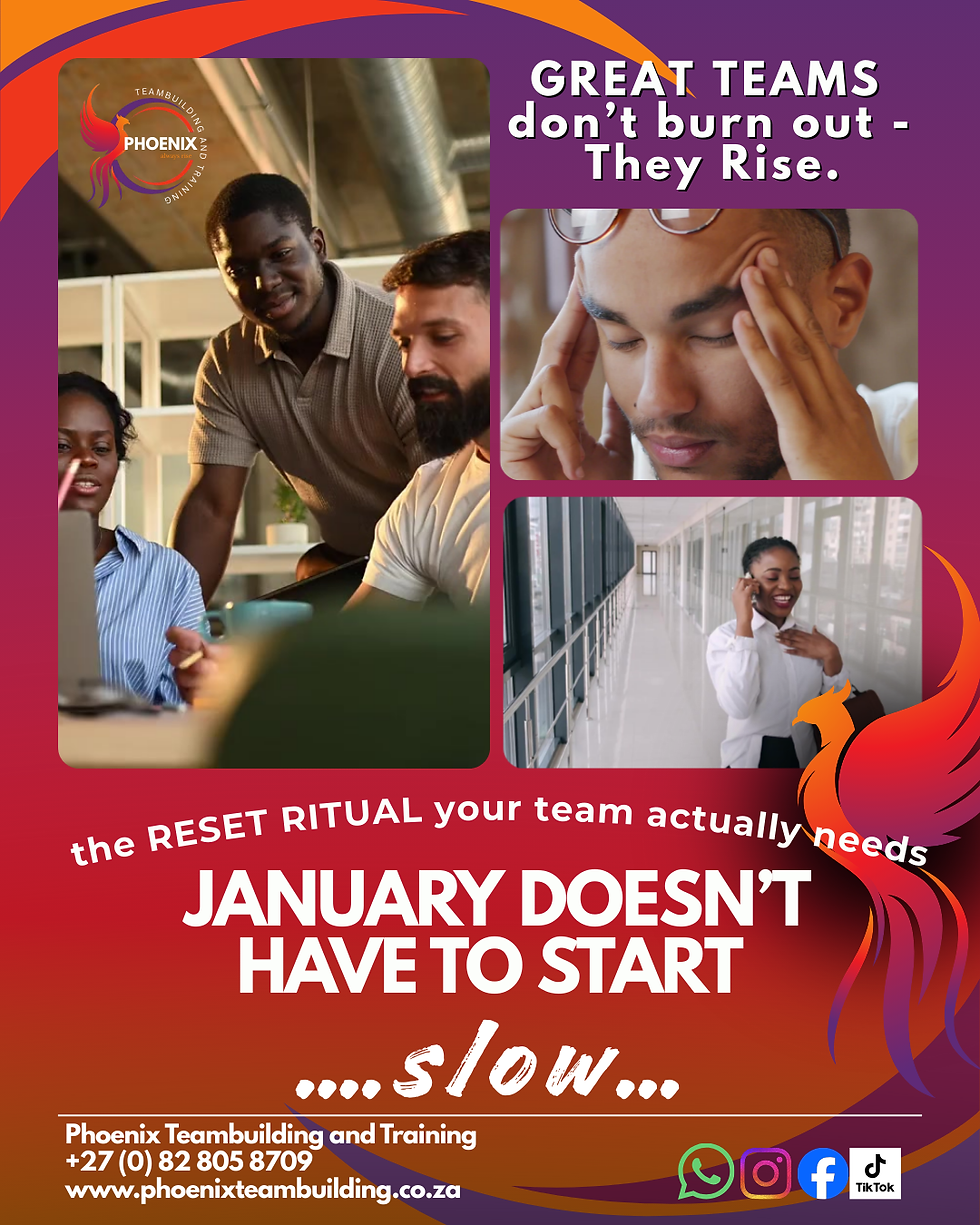
If this resonates, the summary below captures the core idea visually.
Written by
Aletta Du Plessis
Founder & Lead Strategist, Phoenix Teambuilding
Aletta has worked with corporate teams across South Africa, designing and facilitating over 900 team experiences per year. Her work focuses on revealing team dynamics under pressure and translating insight into practical behavioural change through a variety of curated indoor and outdoor activities designed to create the right environment for the right results in safe learning experience for all.

Comments